This second post was the inspiration I needed to sort through a large tub into which I tossed any and all paper as we unpacked. It wasn't all that easy at times to write down notes both for this blog and to help me remember details of the many things we saw and did. (On the Uros Islands, someone asked if I were writing a book. I got the same question once as I was taking notes in Vietnam.) And I took notes on all sorts of paper including boxed lunches.
Next up on the tour was were two days in the Sacred Valley, the area around Cusco.
Side Note #1: People checking the weather on their iPhones (via wi-fi) noted two listings: Cusco and Cuzco. Upon investigation, we learned that in adapting the name to Spanish, the "s" was changed to a "z." "Cusco" is how the locals spell it today, so that's what I'll do, too.
The morning flight from Lima to Cusco was uneventful, fortunately. The tour usually picked up our luggage, so all we had to do upon arrival was hit "the facilities" and get on the bus, where we met our local guide, Fernando.
Side Note #2: Using the "facilities," banos, or bathrooms took some getting used to. Occasionally, one had to pay to pee. The price was usually quite reasonable, typically 1 sol (about 30 cents) or two people for $1.00 US. The admission ticket you were given was good for return visits; I ended up with several different ones in the pockets of various pairs of pants. Paying to use a rest room is something I've done before. Not flushing the toilet paper is not. There was always a small waste receptacle into which you deposited your used toilet paper. The aim is keeping the toilet paper out of the water the sewage goes back into. If I research this a bit and find out whether flushing the paper really is bad for the environment, I'll let you know.
We actually would not be staying in Cusco until after we had visited the Sacred Valley and Machu Picchu. Cusco itself is at an altitude of 11,155 feet, we were going to be going a bit higher, as can be seen here.
Our first stop was to the north of Cusco, at Sacsayhuaman or as Fernando told us as a memory aid, "sexy woman." The Quechua name actually means "satisfied falcon." Sacsayhuaman introduced us to something we would see countless times in the next few days--rock walls made without mortar. And we aren't talking small rocks either.
Stone walls were often constructed as terraces, with the height of each level often being seven or more feet.
The size of the rocks at the base of each level was truly amazing. I can't really imagine how
they would have moved rocks that size and placed them so precisely.
As the walls got higher, the size of the rocks used decreased. Still, they fit together nicely even without mortar.
We had been told assorted signs of altitude sickness--sore throat,
headache, fatigue, sleep problems--and told to stay hydrated. Coca tea
and chocolate were other "remedies" offered. Most importantly, though,
we were told to let someone know if we were feeling any of the symptoms.
One member of the tour did require help at Sacsayhuaman, but that was quickly taken care of so that she could get back to enjoying the tour.
Just driving, well, riding on the bus, through the countryside was interesting. For example, the husband had never heard of quinoa, seen growing here.
By the time the trip was over, though, he'd eaten a great deal of it. We all knew that we would, when having lunch with a Peruvian family, be offered roasted or fried cuy (that's Spanish for guinea pig). It was a little disconcerting, though, to see some actually on a spit.
Our hotel home for two nights in the Sacred Valley was a reworked monastery. It was perfectly natural, then, for the next day to begin with an "Offering to the Earth" ceremony conducted by a local shaman. Various natural ingredients including three coca leaves each of us had held were combined
into a packet to be offered to Pachamama or Mother Earth.
The offering was done via fire.
The ceremony finished, we set off on what may have been the busiest day we had. Our first stop was the Urubamba Market. It reminded me a lot of the markets we saw in Vietnam, something I hope to elaborate on in a future post.
We had been told that if we wanted to take a photo of someone we should offer them 1 sol, which I did to get the following shots.
Look at the size of the squash in the photo below--one that has been cut and another
that has not. In general, vegetables were much larger there than they
are here. Carrots might be three inches in diameter at the base.
The hand below belongs to the husband who was salivating at the size of the batches of quacamole these over-sized avocados would make.
There are 38 varieties of corn grown in Peru, and this is one of them. It can be made into chicha morada, a sweet, non-alcoholic beverage that we had with lunch several times.
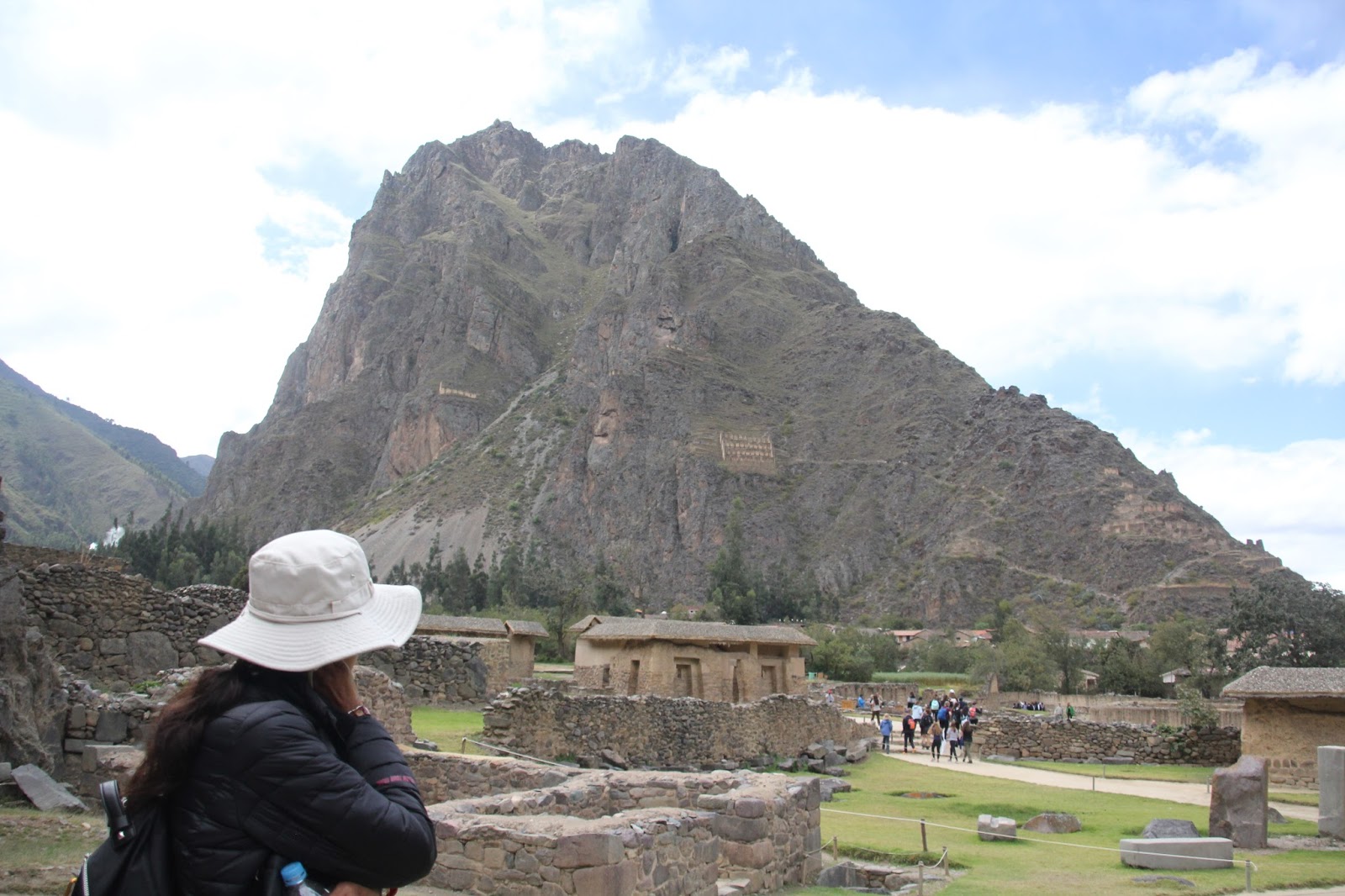
After the market, we went west to Ollantaytambo, which some guide books hold is the best preserved of all the Inca settlements. Best preserved or not, it is definitely impressive both from the bottom
and the top.
You did not have to trek to the top of the many terraces to see one of the more unusual features of Ollantaytambo, a face in the side of the mountain on the other side of the valley.
If you can't see it in the photo above, try the one below.
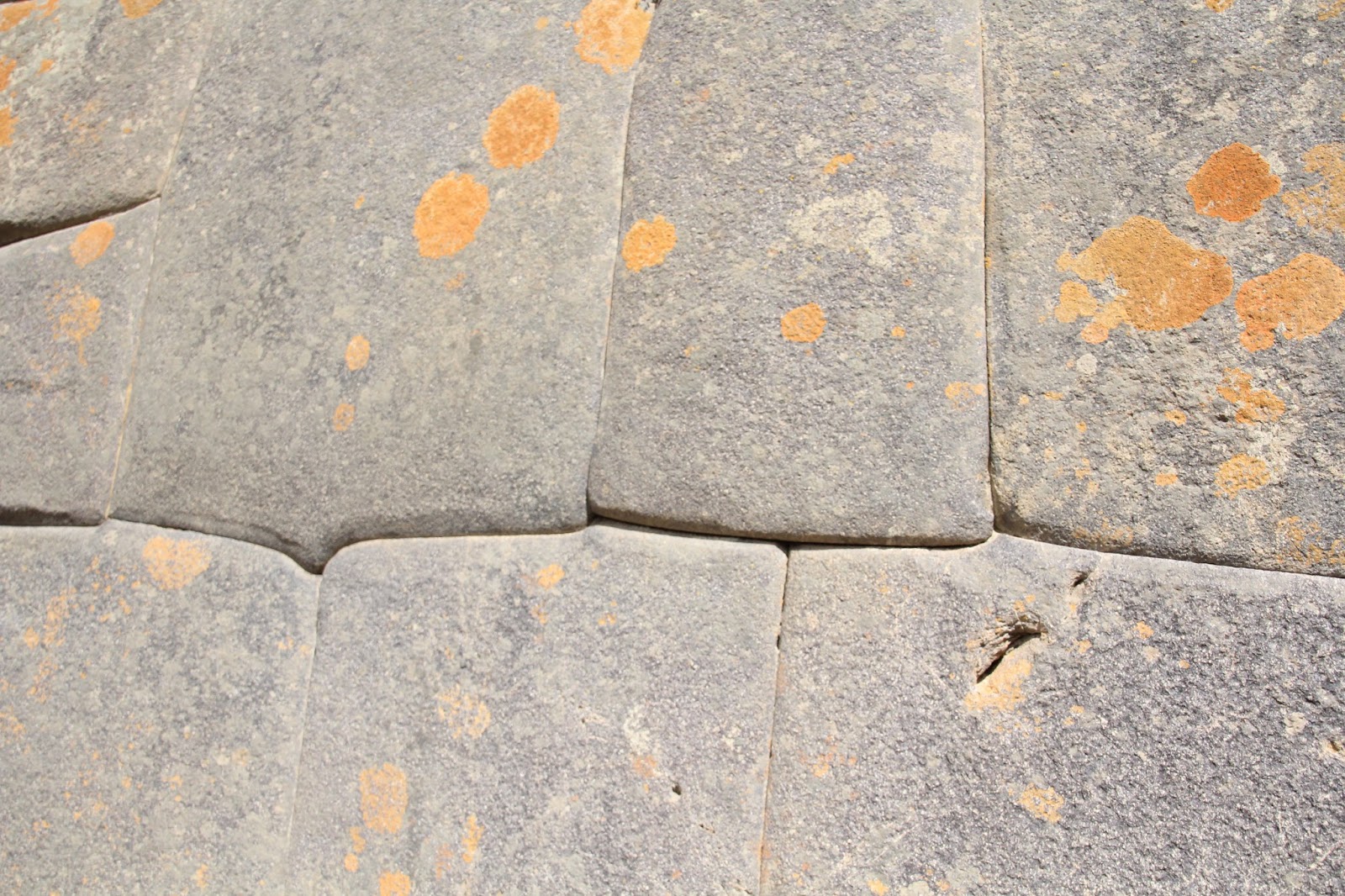
As was getting to feel usual, the placement of the rocks to meet each other with no mortar in between was pretty darn amazing.
How they got the top rock to curve into the seam between the two blocks below it is beyond my comprehension. Never mind that some of the large rocks do not appear to have been mined in the valley below.
I mentioned above that this was a very busy day. Next up was lunch, which turned out to be more a feast than a mere meal. When they brought out some massive platters of meat, we assumed it was the main course and dug right in (except the beef heart--the texture did not at all appeal to me). It turned out that those meats were just part of an appetizer course. Dinner was included at the hotel that night, but more than one of us said we would be skipping it. (The husband and I had soup and a fruit salad.)
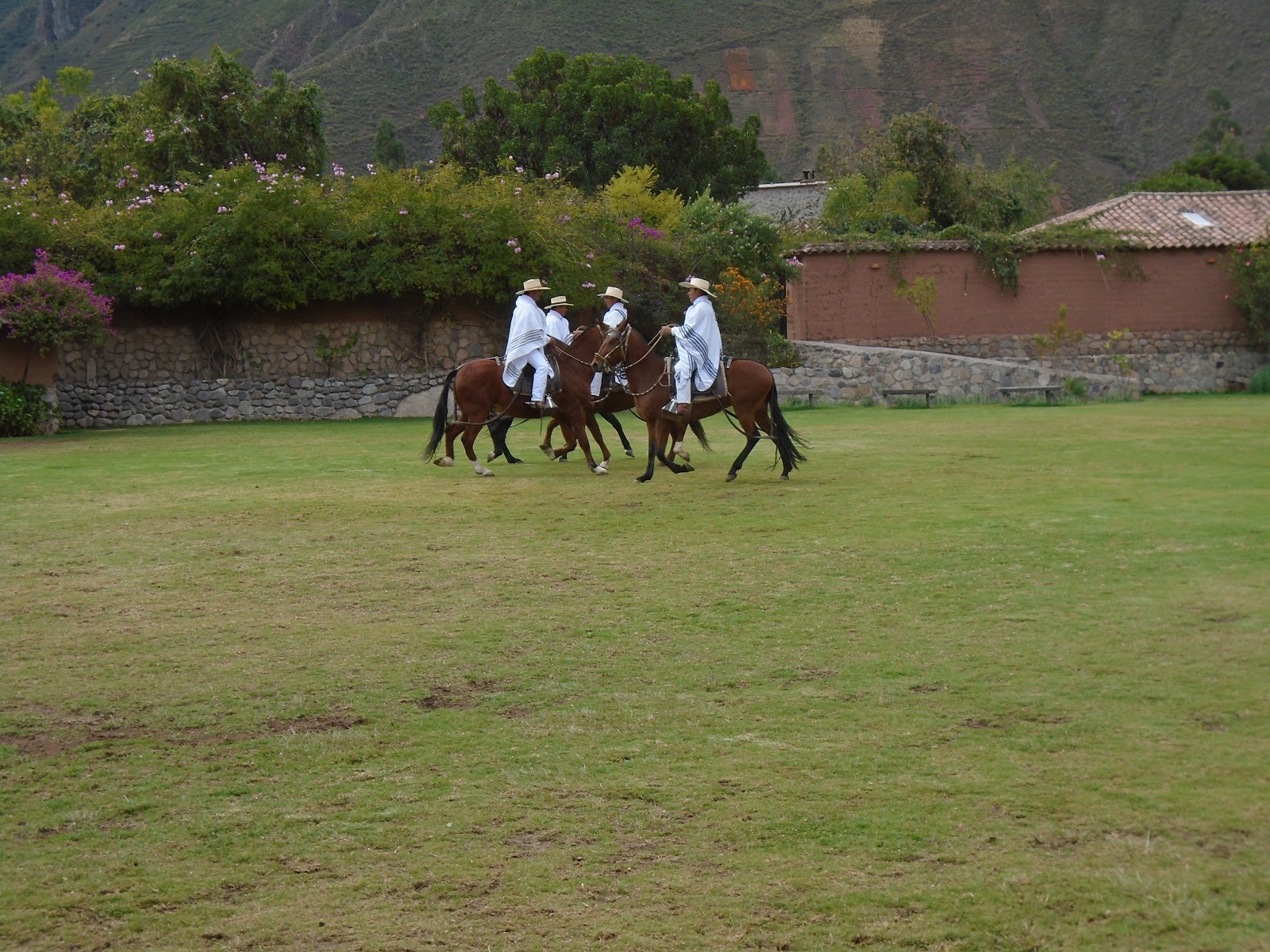
There was not just lunch, though; there was an exhibition of Peruvian horses doing their signature four-beat, lateral gait known as the paso llano. We were told that the gait was ideal for someone learning to ride in that it is quite smooth and steady. The four riders did an elaborate program crossing this way and that, diagonally, around the perimeter of a square, and so on. My photos would not do it justice, so they're staying on my computer.
But it wasn't just horses. There was also dance. First, a female dancer danced with a horse and rider. Later, a male dancer joined in.
After lunch, horses, and dance, we went to what I had most been anticipating that day, a weaving demonstration. It took place in the town of Chinchero. When I posted some photos on Facebook showing how to wrap and carry a baby, one of my friends queried, "Chinchero?" I guess it's a popular place.
The wool is dyed using all natural ingredients.
The wool is washed, again using only natural ingredients.
Then the fleece can be spun into yarn. No spinning wheels here; drop spindles are used.
The spun yarn can then be dyed using those natural dyes shown above.
We also had an interesting demo on how various dye substances combine to give different shades or even different colors.
And the dye does not have to be used only on wool or fabric.
Although we were told that the dye would stay on for 24 hours, it wasn't there at breakfast the next morning. The yarn, once dyed, is woven into all sorts of things--bags, shawls, table runners (what I purchased), even bedspreads.
That finished off the tourist part of the day. We went back to the hotel, some to
pisco sours and a band playing for happy hour, some to a light dinner, some just to be. I think we all may have been a wee bit excited given that the next day would hold what most of us had come to see, Machu Picchu.